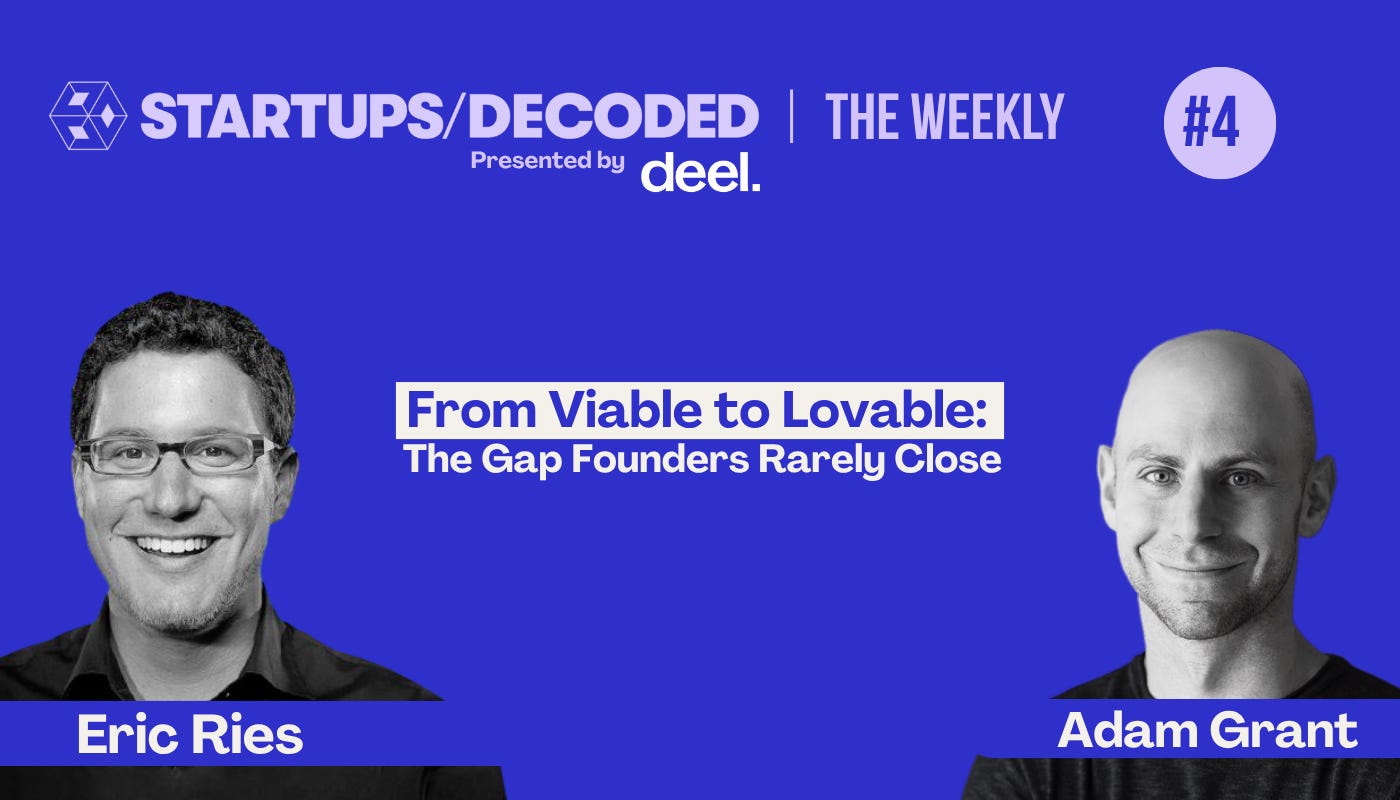
From Viable to Lovable. When Your MVP Moves to MLP. When Eric Ries and Adam Grant Collide.
With Andy Walsh

I love it when ideas collide unintentionally.
When I’m pausing for intentional me time, time to reflect, be bored and see what happens. No agenda, no output, just space. That’s where the good stuff lives for me, the connections I couldn’t have forced if I tried.
I recently had the pleasure of collaborating with Eric Ries on his book launch for Incorruptible. So much of that story sat with me, made me pause and think about the decisions we make as founders. The compromises we justify. The shortcuts we normalize. The moments where we know something is off but we ship anyway because the pressure is real and the runway isn’t.
Eric gave the world the term Minimal Viable Product. MVP. yeah he did! Something the global industry uses every single day, often without knowing where it came from or what it actually meant when he wrote it.
I have a huge pile of books I’m trying to get through, but it grows faster than I can read. I finally made it to Hidden Potential by Adam Grant and got through it in a few days, then started the audiobook to ingrain the knowledge.
Adam talks about Minimal Lovable Product, MLP, and the timing of that connection was not lost on me. My mind was open and the dots connected. It was a moment that made me literally stop and write!
Here’s where I landed.
What MVP actually meant, and what we turned it into.
Eric Ries introduced MVP in The Lean Startup in 2011. The definition was precise: the version of a new product that allows a team to collect the maximum amount of validated learning about customers with the least effort. That’s it. It was a learning tool, not a launch strategy. It was about speed of feedback, not speed to market.
What happened next is what always happens when a useful idea escapes into the wild. It got simplified, then distorted, then weaponized. MVP became the justification for shipping things that weren’t ready. “It’s an MVP” became the thing founders said when they knew something was broken but shipped it anyway. The minimum got kept. The viable got negotiable. The product got forgotten.
I’ve been guilty of this. Most founders have. You’re under pressure, you’re out of time, the investor wants to see traction, and you tell yourself the rough edges are intentional. Lean methodology. Validated learning. You’re not shipping a bad product, you’re running an experiment.
Sometimes that’s true. Mostly it’s you trying to cope.
The data backs this up in a way that should make every founder uncomfortable. According to CB Insights, the number one reason startups fail is building something nobody wants, accounting for around 35% of post-mortems. Not running out of money. Not hiring badly. Not losing to a competitor. Building something people didn’t care about enough to keep using. An MVP that never made the leap to something worth loving.
Founders need to get outside of their own minds, its a dangerous place, ha!
Where MLP comes in.
Adam Grant’s framing in Hidden Potential reframes the whole thing. He’s not writing about product development specifically, he’s writing about growth, potential, and the conditions under which people and ideas actually flourish. But the MLP concept landed hard in that context. Minimal Loveable Product. The smallest version of something that people would genuinely miss if it disappeared.
The word lovable is doing a lot of work there, and it’s worth slowing down on.
Lovable doesn’t mean delightful. It doesn’t mean beautiful or clever or impressive. It means emotionally sticky. It means the product has crossed a line from useful to necessary, from something people use to something people rely on, from a tool to a relationship.
Brian Chesky at Airbnb talks about this with the phrase “design for 11 stars.” He asks his team to describe a one-star experience, then a five-star experience, then push past five into genuinely absurd territory, seven stars, ten stars, eleven stars. What would it take to give someone an experience so good they’d tell everyone they know? You can’t build all of it. You’re not supposed to. The point is to understand what the ceiling looks like so you can consciously decide how far up the wall you want to go. Most products stop at three stars and call it viable.
11 stars shines bright when you see Airbnb ideas, stories, and product evolution, you can taste it!
Paul Graham put it differently, but he was pointing at the same thing. Make something people want. Not need. Not use. Want. The want is where love lives.
Viable means it works. Lovable means it fits.
Most founders think lovable is a design problem. It’s not. You can have a beautiful product someone uses once and forgets. You can have an ugly one they’d genuinely mourn if it disappeared tomorrow. The difference isn’t pixels. It’s how the product makes someone feel about themselves.
Fits their workflow. Fits their mental model. Fits how they want to see themselves. That last one is underrated. People don’t just buy outcomes, they buy identity. The product that earns love quietly tells the user: you’re the kind of person who has this sorted.
There’s research here worth paying attention to. Bain and Company’s work on Net Promoter Score showed that the gap between a customer who rates you a 6 out of 10 and one who rates you a 9 is not a small increment of satisfaction. It’s a fundamentally different emotional relationship. The 6 is viable. The 9 is lovable. The 9 tells people about you. The 6 just keeps using you until something slightly better comes along.
And something slightly better always comes along.
So what actually gets you there.
It removes friction they’d forgotten they had. Not friction they told you about in your user interview. Friction they’d normalised. The best products surface problems people had stopped noticing, which is why you get that “how did I live without this” reaction. Slack is a good example. Email wasn’t broken. Nobody was complaining. The friction of fragmented, slow, searchless team communication had been normalized for decades. Slack didn’t solve a stated problem. It solved a felt one. That’s the seed of love.
It gets faster as they use it. Viable products do the job. Loveable products reward loyalty. Every shortcut, every personalized default, every “we remembered that for you” moment, that’s the product saying I see you. Spotify’s Discover Weekly is a masterclass in this. It gets better the more you use it, which means the longer you stay, the more you lose by leaving. Most founders build entirely for the new user and forget the one who actually stuck around.
It handles failure gracefully. Things break. Errors happen. The products people genuinely love don’t pretend otherwise, they catch you. A thoughtful error message, a smart undo function, a clear “here’s what happened and here’s what to do” — these moments build more trust than ten perfect sessions. Notion does this well. When something goes wrong, the response feels human, almost apologetic. It doesn’t feel like a system error. It feels like a person made a mistake and is owning it. Nobody falls in love with something that pretends to be infallible.
The team’s personality bleeds through. This one is hard to engineer and impossible to fake. Lovable products have a point of view. You can feel the humans behind them. Mailchimp had this for years, the quirky copy, the high-five animation on send, the Freddie mascot. Those details weren’t decoration. They were character. They said we’re a specific kind of company and we built this for a specific kind of person. That comes from founders who aren’t trying to appeal to everyone. They’re building for someone they understand deeply, with conviction, and it shows.
The question that actually matters.
There’s a test I’ve started using. Pull up your product and ask: what would a user lose if this disappeared tomorrow? Not features. Not functionality. What would they actually miss?
Not “would they notice.” Would they miss it. There’s a difference. Lots of products get noticed when they disappear. Bank apps, tax software, procurement tools. Nobody misses them. They just get annoyed and find a replacement within the hour.
The products people miss are the ones that had a personality. That knew them. That made them feel slightly more capable, more organized, more like the version of themselves they were trying to be.
If you can’t answer that question clearly about your own product, you’re still viable. Viable is fine. Viable keeps the lights on. But lovable is what compounds. Lovable is what your users sell for you without being asked. Lovable is what makes churn feel like a personal rejection rather than a pricing problem.
That’s the gap worth closing.
And honestly, reading those two books back to back, Ries and Grant, one about the discipline of building fast and the other about the conditions for genuine growth, I think they were always meant to be read together. MVP gets you in the game. MLP is how you win it.
It has been a fun few weeks. Pause and think people!